Industrial Performance Management: How to Improve Long-Term Results with Digital Visual Management Software
In today's industrial environment, where quality, productivity, employee performance and responsiveness are more critical than ever, industrial performance management has become a strategic priority. Manufacturers need to monitor results in real time, respond quickly to deviations, and align every team around shared objectives. Performance management in manufacturing companies has become a key factor of success.
Yet in many factories, information remains scattered across multiple software applications, Excel spreadsheets, and physical whiteboards leaving areas for improvement in daily management. Performance indicators are not always up to date, action plans are difficult to monitor, and decisions are often based on incomplete or outdated information.
This is where digital visual management software makes a real difference in manufacturing companies. By centralizing data, structuring performance management processes, production process, quality control and improving collaboration across the organization and every team member, it helps companies achieve lasting improvements in operational efficiency.
What is Industrial Performance Management?
Industrial performance management is the process of measuring, analyzing, and continuously improving an organization's performance to achieve its production, quality, safety, and profitability objectives.
It goes far beyond simply monitoring KPIs and performance metrics. An effective performance management system transforms operational data into informed decisions and measurable actions through an efficient visual management system.
To be truly effective, it must answer several essential questions:
- Are operational objectives being achieved?
- Where are the gaps between planned and actual performance?
- Which performance indicators require immediate action?
- Who is responsible for implementing corrective actions?
- Are improvement initiatives delivering the expected results?
When these answers are available in real time and shared across the organization, companies become more agile, responsive, and competitive.
The Limitations of Disconnected Performance Management Tools
Many industrial organizations still rely on a combination of ERP systems, specialized software, Excel spreadsheets, paper forms, visual boards, and internal applications to manage their operations.
This fragmented approach often creates several challenges:
- duplicated or inconsistent data;
- manually updated performance indicators;
- limited visibility into ongoing action plans;
- meetings focused on gathering information rather than making decisions;
- poor traceability of continuous improvement initiatives.
These limitations slow decision-making and reduce the organization's ability to react quickly to production issues.
Why Digital Visual Management is Transforming Industrial Performance
Digital visual management builds on the principles of traditional visual management while leveraging modern digital technologies.
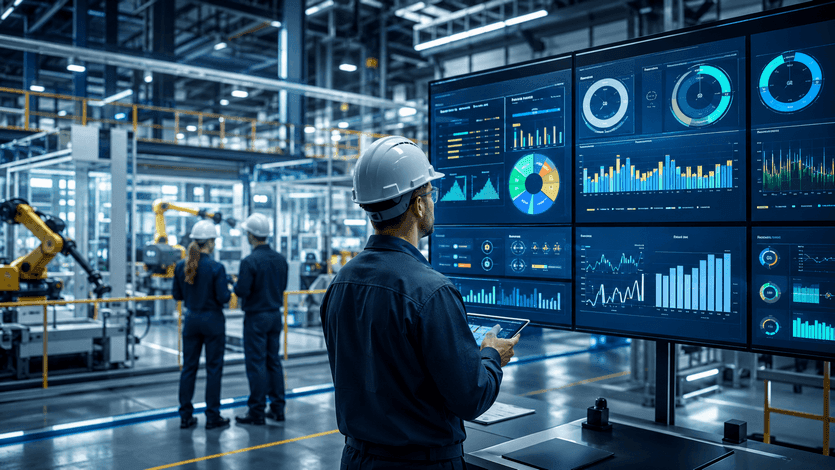
Critical information becomes instantly available through dashboards, digital displays, and collaborative interfaces. Data is updated automatically and shared across every level of the organization, from operators on the shop floor to executive management.
This approach offers several key advantages:
- a shared view of industrial performance;
- faster identification of operational deviations;
- shorter and more productive management meetings;
- improved communication between departments;
- better decision-making based on reliable, real-time data.
Rather than serving as a simple display system, digital visual management becomes a powerful decision-support tool for continuous performance management.
The Key Components of Industrial Performance Management Software
Effective industrial performance management software does much more than display dashboards. It supports every stage of the operational management cycle, like problem solving. This also improves managers performance and boost employee to bridge their skill gaps because they work toward the same goal.
Centralize Performance Indicators
The first step is to consolidate data from multiple departments and business systems into a single source of truth.
With centralized dashboards, performance indicators become available in real time, making it easier to monitor objectives, detect trends, and identify performance gaps.
Turn Data into Action
Identifying problems is only the beginning.
A modern performance management solution enables organizations to structure corrective actions, assign responsibilities, monitor progress, and measure results over time.
Every decision becomes traceable from identification to resolution.
Improve Communication Across Teams
Successful industrial performance management depends on fast and transparent communication.
Thanks to digital visual management, employees have access to the same information whether they are on the production floor, in an office, or working remotely.
This transparency improves collaboration while reducing misunderstandings between departments.
Standardize Operational Processes
Quality audits, inspections, standard operating procedures, document management, and incident reporting can all be integrated into a single digital environment.
Standardized processes improve consistency while ensuring complete traceability across operations.
Connect Existing Business Systems
One of the biggest challenges in industrial organizations is avoiding duplicate data entry.
Modern performance management platforms integrate with ERP, MES, CMMS, and other business applications to automatically collect operational data and maintain reliable performance indicators.
How SESAHUB Supports Industrial Performance Management
SESAHUB has been designed to address every aspect of industrial performance management. This software takes every principle of industry 4.0 and transforms them into a comprehensive industry 5.0 software.
Instead of multiplying disconnected software tools, the platform brings together everything manufacturers need to monitor performance indicators, manage action plans, implement digital visual management, improve team collaboration, organize documentation, and connect existing information systems.
This integrated approach provides several tangible benefits:
- a centralized view of industrial performance;
- reliable performance indicators updated automatically;
- stronger collaboration across teams;
- faster problem resolution;
- more effective communication throughout the organization;
- a structured approach to continuous improvement.
Because SESAHUB adapts to each company's operational needs, it enables organizations to build a complete digital performance management system that supports long-term industrial excellence.
The Benefits of Digitalizing Industrial Performance Management
Digitalizing industrial performance management delivers measurable improvements across the organization.
Managers gain real-time visibility into operations and spend less time collecting data and more time analyzing performance and making informed decisions.
Teams become more autonomous thanks to clearer objectives, transparent priorities, and continuously updated performance indicators.
Action plans remain visible until completion, decisions are fully documented, and organizational knowledge is preserved and shared across departments.
Beyond productivity gains, digital performance management fosters a culture of continuous improvement in which every employee contributes to operational excellence.
Conclusion
Today, industrial performance management involves much more than tracking KPIs in spreadsheets. Organizations need a complete system capable of centralizing operational data, supporting decision-making, coordinating teams, and driving continuous improvement.
By implementing digital visual management software such as SESAHUB, manufacturers transform operational data into concrete actions that sustainably improve industrial performance and operational efficiency. Performance indicators become strategic management tools, shared across the organization and aligned with business objectives.
More than just software, SESAHUB is a comprehensive performance management platform that helps manufacturers accelerate their digital transformation and build a culture of continuous industrial improvement.