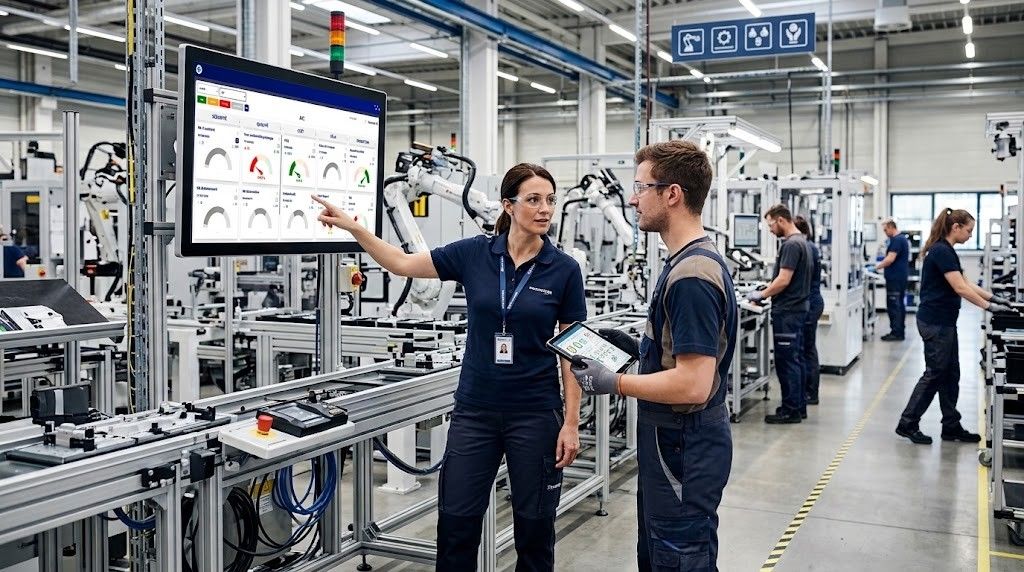
Connected Factory: How Can You Successfully Digitize Visual Management Without Making the Shop Floor More Complex?
The digitalization of manufacturing companies is gradually transforming management and organizational practices. In a connected factory, data moves fast. Equipment communicates with each other. Teams access real-time data to support decisions. This digital transformation raises a key question: how can companies implement digital visual management without making everyday work more complex for employees?
Digitizing Visual Management Without Losing Shop-Floor Simplicity
Visual management has traditionally relied on simple tools such as boards, indicators, displays, action sheets, and Andon lights. These dIn a connected factory, data moves fast.
Equipment communicates with each other. Teams can access real-time data to support decisions.ifferent types of visual management make deviations visible and provide visual aids that are easy to understand for teams working directly on the shop floor.
With digitalization, the goal is not necessarily to eliminate these practices, but to make them more responsive and connected. A visual management system should make information easier to access, simplify updates, and reduce repetitive data entry. Visual management boards and information displays can give a clear view of performance metrics, priorities, and actions.
Teams do not need to use many systems to find this information.
This approach aligns with Lean Management principles.
It removes non-value-added work and makes problems easy to see.
It sets standard work and helps teams respond fast with corrective action.
Connecting Data to Improve Performance Management
In a connected factory, information needs to flow between the company's different systems. Data from production lines, equipment, business software, and the supply chain can feed management tools. It can also help avoid duplicate data entry.
Performance metrics are therefore central to effective visual control. When real-time data is available, teams can better understand the situation. If information is updated often, they can compare results with their objectives.
The main benefits of visual management are not just about showing more information. They are about making useful information visible when it can support action.
This is the approach behind SESAHUB, a performance management platform designed to centralize information and connect different data sources. Its DATA module facilitates exchanges with external systems, helping synchronize data between existing software and SESAHUB.
By connecting these sources, companies can enable real time or near-real-time access to relevant information, depending on the data source and integration setup. This can contribute to greater operational efficiency, particularly when teams need to react quickly to deviations in the production process.
Connecting Information, Analysis, and Action
Digitizing visual management is not simply about replacing a paper board with a screen. The value of a digital solution lies in its ability to connect visual control, analysis, and action.
SESAHUB brings together different performance management uses, including indicators, audits, action plans, tasks, incidents, and information sharing. This approach can support project management and continuous improvement initiatives by giving teams a shared view of actions, responsibilities, and progress.
Digital information can also support different manufacturing processes, from daily performance monitoring to problem-solving and follow-up. When an issue is identified, the objective is not only to display the deviation but also to facilitate the associated corrective action and track its progress.
Artificial intelligence can support certain use cases, particularly when analyzing or structuring information. The goal, however, remains to assist users rather than replace their expertise.
Practical Digitalization for Industry 5.0
Industry 5.0 places particular emphasis on more human-centered technology. This approach aligns with the principles of effective visual management: making information accessible, encouraging collaboration, and enabling teams to act as close as possible to problems.
Successfully implementing digitalization in a manufacturing company therefore does not mean multiplying software tools. It means putting in place an environment where useful information is accessible, understandable, and directly actionable.
By connecting information, performance metrics, and actions, SESAHUB supports the evolution toward a connected factory while maintaining a shop-floor-oriented approach. A digital visual management system makes performance easier to see.
It helps decision-making and reduces downtime.
It also improves overall operational efficiency.
It keeps the simple approach that makes visual management effective.